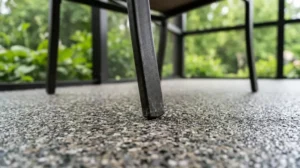
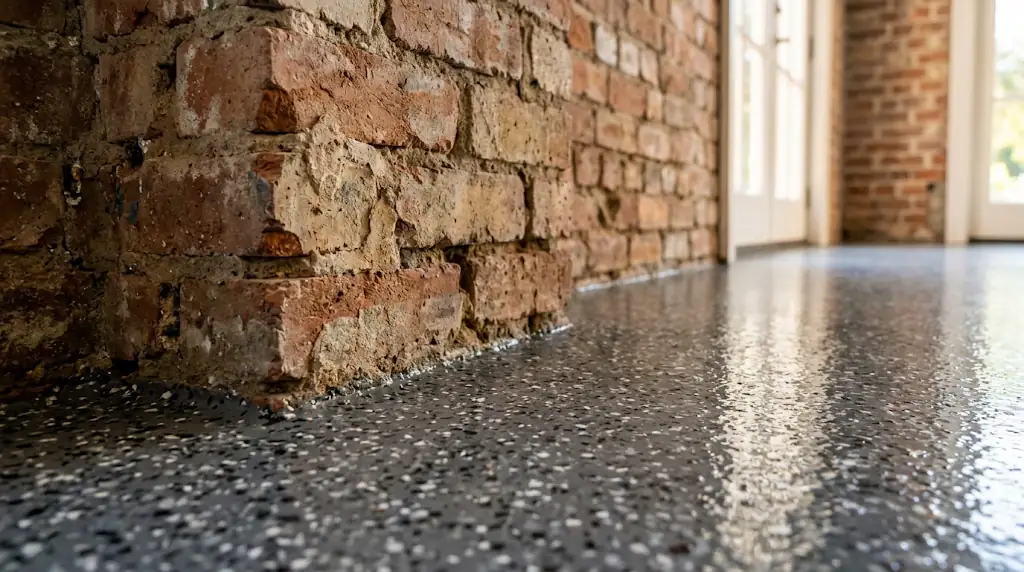
Yes, you can install epoxy over historic concrete slabs in the Savannah area, provided the concrete achieves a minimum tensile pull-off strength of 200 psi and receives structural crack stitching and moisture vapor mitigation. Slabs in historic downtown Savannah, the Victorian District, and Isle of Hope often lack sub-slab vapor retarders and suffer from lime leaching, requiring mechanical diamond grinding and specialized deep-penetrating epoxy primers rather than standard retail coatings.
The Structural Realities of Historic Savannah Concrete
Historic concrete behaves differently than modern slabs poured to contemporary building codes. In properties dating from the late 19th century through the mid-20th century—such as converted carriage houses in downtown Savannah, detached outbuildings in Ardsley Park, or historic riverside estates in Isle of Hope—the concrete presents unique structural variables.
1. Absence of Sub-Slab Polyethylene Vapor Barriers
Modern building codes mandate an unbroken 10-mil to 15-mil polyethylene vapor barrier directly beneath poured residential slabs. Historic slabs laid prior to the 1960s were poured directly onto native Chatham County coastal sand or alluvial fill. Without a sub-slab vapor barrier, groundwater from Savannah’s high water table migrates upward into the slab without resistance. Any coating applied to an unsealed historic slab must resist continuous hydrostatic pressure.
2. High Lime Content and Aggregate Variation
Historic builders in Coastal Georgia frequently mixed cement on-site using regional aggregates, including river rock, crushed oyster shell, and local river sand. These formulations often contain higher concentrations of free lime (calcium hydroxide) and feature lower compressive strength than modern 3,000–4,000 PSI concrete mixes. As moisture passes through the slab, it dissolves the lime, depositing white powdery efflorescence on the surface and weakening the top surface paste.
3. Decades of Hydrocarbon and Organic Contamination
Historic carriage houses, early auto garages, and maintenance sheds have absorbed motor oil, coal soot, kerosene, animal waste, and industrial fluids for generations. Concrete is porous, allowing these contaminants to soak inches deep. Standard surface cleaning will not remove deep-set hydrocarbons; proper mechanical profiling and chemical emulsification are required to ensure coating adhesion.
Evaluating Historic Concrete: Field Testing Standards
Applying a resin floor over historic concrete without pre-testing results in bond failure. Installers must measure structural integrity, moisture emission, and surface hardness before writing a scope of work.
| Diagnostic Test | Standard Protocol | Minimum Threshold for Epoxy | Purpose on Historic Slabs |
| Tensile Pull-Off Strength | ASTM C1583 | Minimum 200 psi (clean concrete break) | Measures whether the concrete paste is strong enough to hold resin without shearing |
| In-Situ Relative Humidity (RH) | ASTM F2170 | Moisture barrier required if > 75% RH | Measures internal water vapor within the slab core |
| Mohs Hardness Scratch Test | Mineral Hardness Scale | Target profile: Mohs 2 to 4 (Soft to Medium) | Determines diamond tooling matrix (soft concrete requires hard-bond diamonds) |
| pH Surface Analysis | ASTM F710 | Safe range: pH 8 to 10 (Remediate if pH 11+) | Detects active alkali leaching and salt accumulation |
If an ASTM C1583 pull-off test results in concrete pulling apart below 200 psi, the surface is too degraded or crumbly for standard coatings. It must be consolidated with a penetrating colloidal silica hardener before resin application.
Historic vs. Modern Slabs: What Changes for Epoxy Installation?
Treating a 90-year-old slab in midtown Savannah like a newly poured garage floor in a Pooler subdivision guarantees floor delamination. The installation approach differs at every step.
| Installation Factor | Modern Suburban Slab (Pooler / Rincon) | Historic Savannah Slab (Downtown / Isle of Hope) |
| Sub-Slab Vapor Retarder | Present (10–15 mil poly plastic) | Absent (Poured directly on native coastal sand) |
| Average Concrete Hardness | Medium to Hard (3,000 – 4,500 psi) | Soft to Medium (1,800 – 2,500 psi) |
| Surface Cracking & Shifting | Minor hairline shrinkage cracks | Deep structural settling fissures and dynamic joints |
| Contamination Level | Minor tire marks, light vehicle fluids | Deep hydrocarbon saturation, mineral efflorescence |
| Surface Profile Technique | Standard mechanical diamond grinding | Precision diamond grinding with low-pressure tooling |
| Moisture Mitigation Strategy | Applied conditionally based on RH test | Mandatory 100%-solids moisture vapor barrier primer |
| Joint Treatment | Polyurea joint fillers | Carbon-fiber stitching + elastomeric polyurea |
The 5-Step Historic Concrete Restoration and Coating Protocol
Applying resin systems over aging lowcountry concrete requires mechanical remediation, structural repairs, and chemical moisture control.
1. Deep Chemical Decontamination and Degreasing
Solvent degreasers and microbial cleaning solutions are applied to hydrocarbon-saturated zones. Severe oil saturation requires repeated thermal poultice treatments to draw subsurface motor fluids out of the capillary network before diamond grinding begins.
2. Controlled Mechanical Grinding (No Acid Etching)
Acid etching must never be used on historic concrete. Muriatic acid attacks the already weakened calcium hydroxide paste, dissolving critical matrix bonds and dumping water into a slab that lacks a vapor barrier.
Instead, technicians use heavy rotary floor grinders with vacuum-assisted HEPA containment systems. Soft historic concrete requires hard-bond segmented diamond tooling to establish a Concrete Surface Profile (CSP) of 2 to 3, adhering to guidelines established by the International Concrete Repair Institute.
3. Structural Crack Chasing and Carbon-Fiber Stitching
Historic foundations in Greater Savannah regularly settle due to changes in water levels and soft subsurface soils. Active fractures cannot simply be covered with paint.
- Cracks are opened using diamond-tipped v-blade tuck-pointers.
- Transverse slots are cut perpendicular to major structural cracks every 12 to 18 inches.
- High-tensile carbon-fiber stitches or steel staples are embedded across the fracture using structural epoxy gel.
- The routed crack channel is filled flush using rigid, low-viscosity polyurea repair polymers to prevent crack telegraphing through the final coating.
4. 100%-Solids Moisture Vapor Barrier Application
Because historic slabs pull moisture from high coastal water tables, an industrial-grade moisture vapor barrier (MVB) primer is applied. This deeply penetrating primer flows into the opened pore structure, reacting chemically with residual moisture to form an impenetrable mechanical anchor capable of resisting over 20 lbs of hydrostatic head pressure.
5. Flexible Resin Build and UV-Stable Polyaspartic Wear Layer
Historic outbuildings experience structural vibration and minor thermal movement. A high-build flexible epoxy or polyurea intermediate coat accommodates microscopic slab deflection. The floor is then finished with an aliphatic polyaspartic topcoat, protecting the floor from chemical spills, abrasion, and sunlight through open carriage doors.
Regional Considerations Across Historic Coastal Georgia
Different historic areas around Savannah present specific slab challenges:
- Downtown Savannah & Victorian District: Converted carriage houses often have thin, unreinforced concrete poured over brick ballast or packed earth. These floors require low-weight diamond tooling to avoid fracturing the brittle slab.
- Isle of Hope & Bluff Neighborhoods: Low-elevation sites near the marsh experience tidal moisture cycling. Slabs stay saturated year-round, requiring high-performance moisture vapor barrier primers.
- Ardsley Park Detached Garages: Mature live oak tree roots regularly push under 1920s-era garage slabs, causing heaving and uneven joints. Slabs must be diamond-leveled across offset joints prior to resin application.
Consult a Historic Concrete Coating Specialist
Historic concrete slabs can be successfully coated, but they require diagnostic testing, crack repair, and moisture control that basic painting crews cannot provide. Professional surface preparation preserves the integrity of your historic structure while delivering a modern, clean, and durable floor.
To evaluate your historic concrete and schedule an on-site testing consultation in Greater Savannah, visit our contact page to speak with the specialists at Savannah Epoxy Flooring.