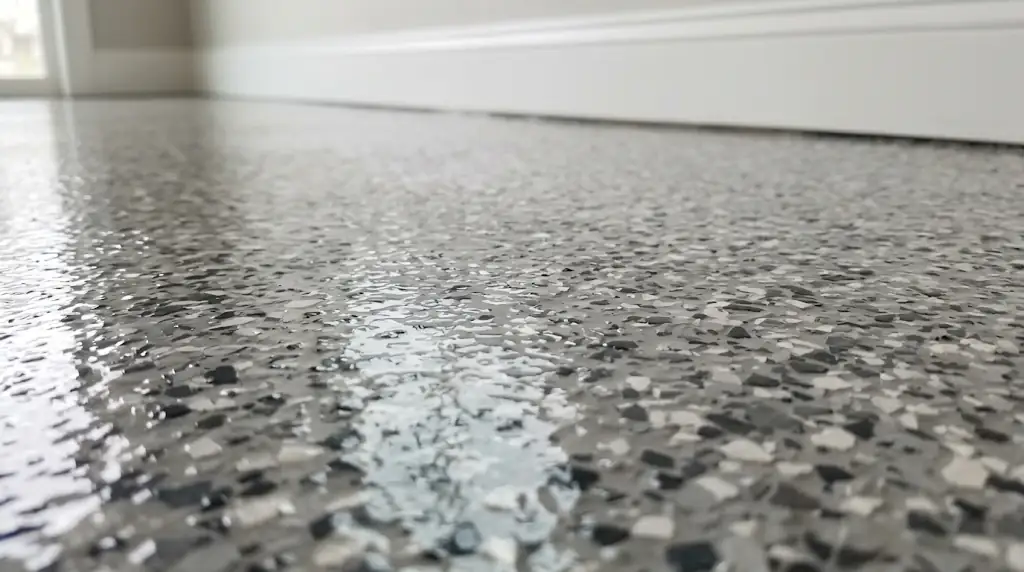
Professional epoxy flooring in Greater Savannah costs between $4.50 and $11.00 per square foot for standard residential installations, with specialty metallic or commercial-grade systems reaching $9.00 to $14.00 per square foot. For an average 400-to-500-square-foot two-car garage, homeowners across Chatham, Bryan, and Effingham counties typically invest between $2,200 and $5,200 for a complete, professionally installed multi-layer system.
Epoxy Flooring Cost Breakdown by System Type
The primary cost determinant is the coating formulation and the number of layers applied. A durable floor requires an epoxy primer, a base coat, decorative broadcast media (if applicable), and a UV-stable topcoat.
| Flooring System | Price per Sq. Ft. | 450 Sq. Ft. Garage (2-Car) | Best Use Case |
| Solid Color Thin-Mil Epoxy | $4.50 – $6.50 | $2,025 – $2,925 | Low-traffic utility rooms, interior basements |
| Full Decorative Flake System | $5.50 – $8.50 | $2,475 – $3,825 | Standard residential garages, patios, workshops |
| High-Build Metallic Epoxy | $9.00 – $14.00 | $4,050 – $6,300 | Showrooms, residential interiors, retail spaces |
| Moisture Vapor Barrier + Epoxy | $7.00 – $11.00 | $3,150 – $4,950 | Lowcountry slabs with high hydrostatic pressure |
| Commercial Epoxy / Polyaspartic | $8.00 – $15.00 | $3,600 – $6,750 | Auto shops, industrial facilities, warehouses |
Cost by Square Footage Across Common Garage Sizes
Garage footprints vary by neighborhood and home age. Newer master-planned communities in Pooler and Richmond Hill often feature oversized two- or three-car bays, while historic properties in downtown Savannah and Isle of Hope frequently have compact detached structures.
- Single-Car Garage (200 – 250 sq. ft.): $1,200 – $2,500. Smaller spaces have a higher cost per square foot because fixed equipment mobilization and diamond tooling setup costs are distributed across fewer square feet.
- Standard Two-Car Garage (400 – 500 sq. ft.): $2,200 – $4,250. This represents the regional baseline for a full-broadcast vinyl flake system with an aliphatic polyaspartic clear topcoat.
- Large Three-Car Garage (600 – 800 sq. ft.): $3,600 – $6,800. Larger footprints unlock volume efficiencies, lowering the raw cost per square foot toward the lower end of the pricing band.
- Detached Outbuildings & Pole Barns (1,000+ sq. ft.): $4,500 – $8,500+. Slabs over 1,000 square feet often require dedicated expansion joint filling and additional mechanical grinding time.
Why Coastal Georgia Pricing Differs from National Averages
National home-improvement sites cite average epoxy costs between $3.00 and $7.00 per square foot. Those estimates do not account for coastal environmental factors unique to Southeast Georgia. Slabs in Greater Savannah face extreme moisture vapor transmission, high salt-air exposure, and prolonged summer heat.
1. High Water Tables and Slab Moisture Testing
Chatham and Bryan counties feature shallow water tables, frequently sitting less than three to five feet below the surface on Wilmington Island, Isle of Hope, and coastal Richmond Hill. Ground moisture migrates upward through porous concrete via capillary action.
When trapped beneath an impermeable coating, hydrostatic pressure causes delamination and blistering. To prevent failure, concrete must be tested for relative humidity in accordance with ASTM F2170. If internal slab relative humidity exceeds 80%, a dedicated 100%-solids moisture-vapor barrier primer is mandatory. This adds $1.50 to $2.50 per square foot to the base installation cost, but prevents coating failure.
2. Concrete Surface Profile (CSP) Preparation
Acid etching is insufficient for long-term adhesion in coastal climates. Professional installation requires mechanical diamond grinding or shot blasting to achieve a Concrete Surface Profile (CSP) of 2 or 3, as defined by the International Concrete Repair Institute (ICRI).
Mechanical grinding opens the concrete pores and strips away surface laitance, curing compounds, and chemical contaminants. Industrial dust extractors with HEPA filters keep airborne silica below OSHA limits during this stage. Surface preparation accounts for roughly 30% of total project labor and tooling expenses.
3. Concrete Repair and Age of the Slab
The physical condition of the substrate directly impacts the final estimate:
- Settled and Cracked Concrete: Historic concrete in older Savannah neighborhoods and established Isle of Hope properties often requires polyurea crack chasing, deep spall patching, and leveling before coating application. Crack repairs add $5 to $12 per linear foot.
- New Construction Outgassing: Newer builds in Bloomingdale, Rincon, and Pooler require a full 28-day cure period for the concrete before coating. Fresh slabs often retain excess moisture that must be addressed with moisture-tolerant primers.
- Oil and Chemical Contamination: Driveway-adjacent and workspace slabs saturated with motor oil or brake fluid require chemical degreasing and thermal remediation to allow mechanical bonding.
4. Polyaspartic vs. Polyurethane Topcoats
Standard epoxy resins amber and degrade when exposed to ultraviolet radiation. Garage aprons, open carports, and screened lanais in Coastal Georgia require a UV-stable topcoat.
Upgrading from a standard polyurethane clear coat to an aliphatic polyaspartic topcoat adds $1.00 to $2.00 per square foot. Polyaspartic chemistry provides faster return-to-service times (walkable in 6 hours, vehicle-ready in 24 to 48 hours) and resists hot-tire pickup caused by high ambient road temperatures during Georgia summers.
Professional Installation vs. DIY Epoxy Kits
Big-box home improvement stores sell water-based epoxy paint kits for $100 to $250. These products differ fundamentally from industrial resin systems in solids content, thickness, and longevity.
| Feature | Big-Box DIY Kit | Professional System (Savannah Epoxy Flooring) |
| Material Chemistry | Water-based or solvent-based paint | 100% solids epoxy base + polyaspartic topcoat |
| Coating Thickness | 2 to 4 mils (dry film thickness) | 20 to 35+ mils (dry film thickness) |
| Surface Preparation | Muriatic acid wash | Heavy diamond grinding (ICRI CSP 2–3) |
| Moisture Mitigation | None included | ASTM-verified vapor barriers applied as needed |
| Hot-Tire Resistance | Low (peels within 12–24 months) | Complete resistance to thermal plasticizer migration |
| Expected Lifespan | 1 to 3 years | 15 to 20+ years |
| Initial Cost (500 sq. ft.) | $300 – $600 (materials only) | $2,475 – $4,250 (full labor, tooling, materials) |
Attempting a DIY install on a damp slab frequently results in peeling sheets within the first summer. Stripping failed DIY paint before applying a professional system requires aggressive diamond grinding, which adds $1.50 to $2.00 per square foot in labor and tooling costs to the eventual professional install.
Getting an Exact Estimate in Greater Savannah
Square footage provides a baseline, but accurate pricing requires an on-site evaluation of concrete hardness, moisture vapor pressure, and crack severity. Slabs near salt marshes on Wilmington Island present different preparation requirements than dry commercial slabs in Pooler logistics centers.
To schedule an on-site inspection and receive a line-item quote for your space, visit our contact page to connect with a technician at Savannah Epoxy Flooring.