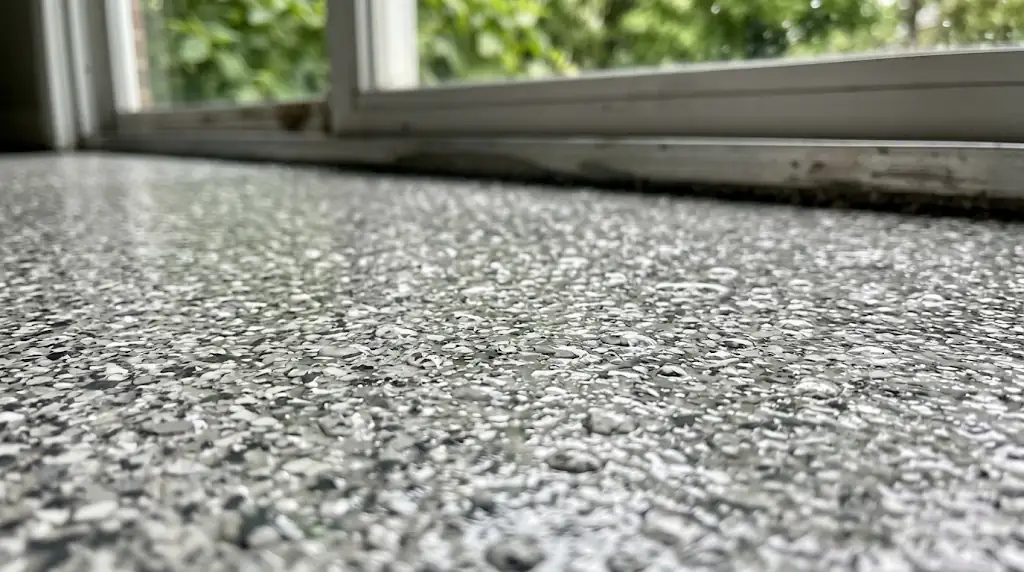
Yes, epoxy flooring handles Coastal Georgia’s humidity and slab moisture, but only if installed over a dedicated 100%-solids moisture vapor barrier (MVB) primer. Standard, direct-to-concrete epoxies fail in Chatham, Bryan, and Effingham counties because lowcountry slabs sit above high water tables that generate severe hydrostatic pressure.
Why Coastal Georgia Slabs Destroy Standard Epoxy
Concrete is porous. Under microscopic examination, cured concrete acts like a dense sponge filled with interconnected capillary tubes. In coastal environments, moisture in the surrounding soil constantly moves upward toward the surface.
[Capillary Action: Ground Moisture] ➔ [Porous Concrete Slab] ➔ [Trapped Beneath Coating] ➔ [Hydrostatic Blisters]
When an impermeable coating seals the top of the slab without an integrated vapor mitigation system, that upward migration stops at the surface bond line. This creates two distinct structural failure mechanisms:
- Hydrostatic Pressure: Rising water vapor exerts upward physical pressure against the coating. Standard residential epoxies tolerate only 3 to 5 pounds of pressure per 1,000 square feet over 24 hours. Coastal slabs regularly register two to three times that threshold, shearing the coating off the concrete.
- Osmotic Blistering: Moisture trapped beneath the film pulls water-soluble salts and alkalis out of the concrete paste. This creates pockets of concentrated alkaline fluid with a pH of 12 or higher. The resulting osmotic pressure draws more liquid to the pocket, forming fluid-filled bubbles that crack, leak white residue, and peel away in sheets.
- Sweating Slab Syndrome (SSS): In non-climate-controlled spaces like garages and open carports, warm, humid marine air collides with cool concrete. When the slab temperature drops below the air’s dew point—a frequent condition during Savannah summers, where average relative humidity hovers between 70% and 80% according to the National Weather Service—condensation covers the surface. Standard paints peel under these repeated wetting cycles.
Testing Slab Moisture: ASTM Standards
Visual checks cannot determine if a slab is ready for a resin system. Concrete that looks bone-dry on the surface can hold critical levels of saturation two inches below. Professional installers rely on objective testing standards before selecting an epoxy formulation.
| Testing Method | Relevant Industry Standard | How It Works | Threshold for MVB Primers |
| In-Situ Relative Humidity (RH) | ASTM F2170 | Electronic sensor probes inserted into drilled holes at 40% of the slab’s total depth | Required if internal RH exceeds 75% to 80% |
| Calcium Chloride (MVER) | ASTM F1869 | Sealed dome containing anhydrous calcium chloride weighs moisture output over 72 hours | Required if vapor emissions exceed 3.0 lbs / 1,000 sq. ft. / 24 hrs |
| Electronic Impedance | ASTM F2659 | Non-destructive surface impedance meter used for rapid comparative site scanning | Used for instant baseline mapping across large bays |
In-situ RH testing via ASTM F2170 is the definitive standard for garage slabs. Calcium chloride testing measures only the top 3/4-inch of the concrete and frequently yields false negatives in air-conditioned garages or during brief dry spells.
Standard Epoxy vs. 100%-Solids Moisture Vapor Barrier Systems
Applying standard retail epoxy in Greater Savannah without measuring moisture ensures coating failure within 12 to 24 months. Professional installations apply a dedicated, deeply penetrating moisture-blocking primer formulated to withstand high pressure.
| Performance Metric | Standard Big-Box Epoxy Kit | Professional Moisture Vapor Barrier (MVB) |
| Moisture Vapor Emission Limit | Up to 3.0 lbs / 1,000 sq. ft. / 24 hrs | Up to 20.0–25.0 lbs / 1,000 sq. ft. / 24 hrs |
| Internal Relative Humidity Limit | 75% Maximum RH | Up to 95%–99% RH (Deep slab saturation) |
| Solids Content by Volume | 40% to 60% (Diluted with water/solvents) | 100% Solids (Zero evaporation loss during cure) |
| Tensile Adhesion to Concrete | 150 – 250 psi | 400+ psi (Exceeds concrete tensile strength) |
| Resistance to High Alkalinity | Degrades at pH 10+ | Resists sustained chemical exposure at pH 14 |
| Hot-Tire Plasticizer Resistance | Low (Delaminates under warm tires) | Complete permanent barrier |
A true MVB primer bonds at a molecular level inside the capillary network of the concrete, curing into a dense, non-porous plug that locks hydrostatic moisture below the surface.
Local Microclimates: Greater Savannah Risk Profiles
Geology and site elevation dictate the level of moisture mitigation a concrete slab requires across the lowcountry.
1. High-Risk Marsh and Island Slabs: Wilmington Island & Isle of Hope
Properties bordered by tidal creeks, salt marshes, and river cuts sit on shallow water tables. Slabs frequently rest three to six feet above sea level. Without an intact poly-vapor retarder underneath the slab—a common absence in homes built prior to 1990—groundwater sits directly against the bottom of the concrete foundation. MVB epoxy primers are mandatory on these properties.
2. Settled & Aging Slabs: Historic Savannah & Mid-City
Historic Savannah properties feature concrete with decades of micro-cracking, settling, and lime leaching. These slabs must be mechanically remediated, patched with high-modulus structural polymers, and sealed against vapor intrusion before receiving any decorative system.
3. Rapid Hydration and Clay Basins: Pooler, Bloomingdale, & Rincon
West Chatham and Effingham county developments sit on heavy alluvial soils and dense clay that hold rainwater for days after storms. In new construction subdivisions throughout Pooler and Bloomingdale, slabs must cure for at least 28 to 30 days before testing. Fresh concrete continues to release internal water of hydration; applying an epoxy system too quickly without testing traps this water, resulting in chemical debonding.
4. Coastal River Basins: Richmond Hill
Located near the Ogeechee River basin, Richmond Hill properties often deal with high soil saturation levels and shifting moisture content between rainy seasons and summer dry stretches. This continuous expansion and contraction requires dynamic polyurea joint fillers alongside moisture-tolerant primers to maintain an unbroken floor seal.
The 4-Step Installation Protocol for Damp Slabs
To guarantee a permanent bond on high-moisture coastal concrete, Savannah Epoxy Flooring follows a strict mechanical and chemical installation procedure:
- Mechanical Diamond Grinding: Acid washing is never used. Acid injects gallons of additional water into an already damp slab and fails to create an adequate anchor profile. Walk-behind industrial grinders equipped with coarse diamond tooling scarify the surface to an ICRI Concrete Surface Profile (CSP) of 2 to 3, established by the International Concrete Repair Institute.
- Moisture & Joint Remediation: Expansion joints and stress fractures are cleaned, chased with a diamond wheel, and filled with a low-viscosity, fast-curing polyurea joint filler.
- Application of 100%-Solids MVB Epoxy: The specialized vapor-barrier epoxy is rolled onto the open slab. It penetrates deep into the concrete pores, creating an impermeable barrier capable of withstanding up to 25 lbs of hydrostatic head pressure.
- Aliphatic Polyaspartic Topcoat: Once the decorative flake or metallic broadcast coat is placed, a fast-curing polyaspartic topcoat seals the system. Polyaspartic topcoats are 100% UV-stable, meaning they will not yellow, chalk, or soften under the intense heat and humidity common to coastal Georgia garages and covered patios.
Schedule an On-Site Moisture Test in Savannah
Slab moisture is invisible until your floor begins to bubble and peel. Investing in a professional installation with certified moisture testing protects your garage, showroom, or warehouse against coastal water tables and humidity failures.
To schedule an on-site evaluation and get an accurate, line-item estimate for your property, contact the local coating specialists at Savannah Epoxy Flooring through our contact page.