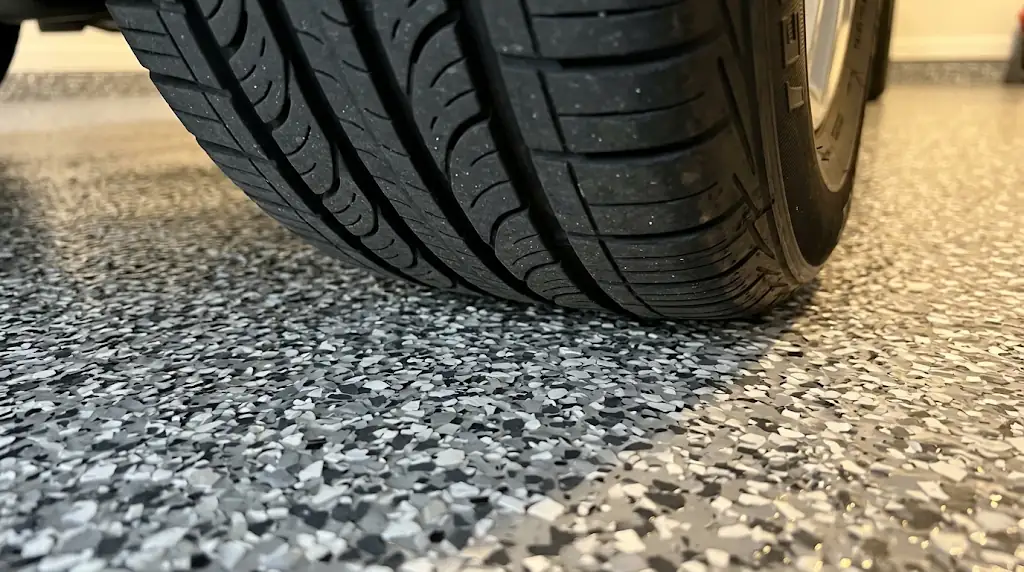
Polyaspartic topcoats withstand Savannah heat and hot-tire pickup significantly better than standard epoxy, maintaining structural stability past 300°F compared to epoxy’s 140°F heat deflection threshold. While standard epoxy softens under hot radial tires driven across scorching coastal asphalt, an aliphatic polyaspartic coating remains chemically rigid, preventing tire marks, peeling, and thermal delamination.
The Physics of Hot-Tire Pickup in Coastal Georgia
Hot-tire pickup is the most common mechanical failure observed in residential garage floors. It occurs through a combination of thermal friction, chemical plasticizer migration, and cooling contraction.
During summer months in Chatham, Bryan, and Effingham counties, ambient temperatures frequently exceed 90°F. According to heat monitoring data from the National Weather Service, dark asphalt road surfaces absorb radiant solar energy and reach temperatures between 135°F and 150°F. Commuting at highway speeds along I-95, I-16, or the Truman Parkway generates additional frictional heat inside the tire belts.
When a vehicle parks on a garage floor after a prolonged drive, that accumulated heat transfers directly into the concrete:
- Thermal Softening: Standard epoxy begins to soften at temperatures as low as 130°F to 140°F. The intense contact heat from the tire footprint drops the surface hardness of the resin film.
- Plasticizer Migration: Modern automobile tires contain synthetic polymer compounds and chemical plasticizers added for road grip. Under extreme heat and pressure, these plasticizers leach out of the tire rubber and diffuse directly into the softened epoxy resin.
- Mechanical Bond & Shrinkage: As the parked car sits, the tires cool and contract. The tire tread mechanically locks onto the softened epoxy. When the vehicle is driven out of the garage, the cooling tire physically pulls the compromised epoxy coating away from the concrete slab.
Epoxy vs. Polyaspartic: Technical Specification Comparison
Evaluating resin coatings requires examining physical performance metrics established by standard laboratory testing. The following table contrasts industrial 100%-solids epoxy with aliphatic polyaspartic coatings.
| Physical Property | 100%-Solids Industrial Epoxy | Aliphatic Polyaspartic | Superior System |
| Heat Deflection Temperature | 130°F – 140°F | 300°F – 350°F | Polyaspartic |
| Tensile Elongation (Flexibility) | 3% to 8% | 25% to 100% | Polyaspartic |
| Taber Abrasion (mg loss, CS-17, 1000 cycles) | 40 – 60 mg loss | 15 – 25 mg loss | Polyaspartic |
| Concrete Pull-Off Adhesion | 400+ psi (Substrate failure) | 350 – 400 psi | Epoxy |
| UV Stability (Non-Yellowing) | Poor (Aromatic ring ambers) | Exceptional (Aliphatic backbone) | Polyaspartic |
| Pot Life / Working Time | 30 to 45 minutes | 15 to 25 minutes | Epoxy |
| Walkable Return-to-Service | 18 to 24 hours | 4 to 6 hours | Polyaspartic |
| Full Vehicle Return-to-Service | 5 to 7 days | 24 to 48 hours | Polyaspartic |
| Chemical & Stain Resistance | High (Degrades with brake fluid) | Extreme (Impervious to hydrocarbons) | Polyaspartic |
Laboratory wear evaluation per ASTM D4060 proves that polyaspartic films experience less than half the volume loss of epoxy when subjected to abrasive friction. However, tensile adhesion evaluations under ASTM D7234 demonstrate that high-solids epoxies form a slightly deeper mechanical bond into open concrete pores.
Why Polyaspartic Resists Hot-Tire Pickup
Polyaspartic is an aliphatic polyurea coating. Its internal molecular architecture creates three primary advantages over epoxy in high-heat garage environments:
1. High Thermal Deflection
Polyaspartic resins feature a cross-linked polyurethane network that does not soften until temperatures exceed 300°F. Even if a vehicle pulls directly into a garage in Pooler or Rincon after an hour of high-speed hauling on sun-baked highways, the tire’s 145°F tread temperature cannot drop the polyaspartic film below its glass transition state.
2. High Tensile Elongation
Standard epoxy cures into an exceptionally hard, rigid crystal matrix with an elongation rating under 8%. As concrete slabs expand and contract under coastal Georgia’s cycling temperatures, rigid epoxy cracks under shear stress. Polyaspartic retains an elongation rating between 25% and 100%, flexing alongside minor slab movements and tire shear forces without delaminating.
3. Total Chemical Inertness to Tire Compounds
The fully cured polyaspartic surface creates a tight polymer barrier that repels plasticizers, motor oil, hot transmission fluids, and road salt. Plasticizers cannot penetrate the cross-linked clear coat, preventing the chemical weld that causes hot-tire peel.
The Critical Weakness of Standard Epoxy in Savannah: Sunlight and Aprons
Beyond hot-tire pickup, ultraviolet (UV) radiation poses a significant risk to exterior concrete coatings throughout Greater Savannah.
Most epoxy formulations are aromatic. The chemical rings within aromatic polymers break down when struck by UV light, causing standard epoxies to turn amber or yellow within 6 to 12 months. This breakdown also causes chalking, a process where the surface degrades into a fine powder, eliminating gloss and scratch resistance.
Garage doors left open during daylight hours allow UV radiation to reach the first two to four feet of the slab—the garage apron. While aromatic epoxy degrades and yellows under direct sun, aliphatic polyaspartic coatings are 100% UV-stable. Polyaspartic topcoats maintain optical clarity and resist yellowing even on open carports, driveways, and screened lanais on Wilmington Island and Richmond Hill.
The Hybrid System: The Best Solution for Greater Savannah
Neither 100% pure epoxy nor pure polyaspartic represents a complete standalone floor system. Experienced contractors deploy a multi-layer hybrid coating system that leverages the mechanical strengths of both chemistries.
- Base Layer (100%-Solids Epoxy Moisture Barrier): Epoxy has a slower cure time and lower initial viscosity, allowing it to wick deeply into the concrete’s open capillary network after diamond grinding. It bonds directly with the concrete paste and acts as a moisture vapor barrier against high water tables.
- Mid-Layer (Decorative Vinyl Flake): A full broadcast of colored vinyl flake creates surface texture, hides concrete imperfections, and adds impact-absorbing mass to the floor.
- Top Layer (Aliphatic Polyaspartic Clear Coat): The polyaspartic coat encases the flakes, creating a hard, UV-stable, chemical-resistant wear layer that directly contacts hot vehicle tires.
By pairing an epoxy moisture-mitigating primer with a heavy-duty polyaspartic topcoat, property owners get the deep substrate adhesion of epoxy alongside the extreme heat and UV resistance of polyaspartic.
Local Performance Across Greater Savannah Communities
Vehicle types, parking habits, and driving environments differ across regional municipalities:
- Pooler & Bloomingdale Commuter Garages: High-speed commuting along the I-16 corridor produces maximum tire heat. Hybrid systems with polyaspartic topcoats prevent daily hot-tire pickup from highway driving.
- Wilmington Island & Isle of Hope: Slabs are exposed to constant salt air and open breezes. Polyaspartic finishes seal the concrete against salt pitting and protect covered lanais from intense direct sunlight.
- Rincon & Richmond Hill Work Truck Bays: Heavy pickup trucks, boat trailers, and utility vehicles exert extreme point loads. Polyaspartic’s high Taber abrasion resistance prevents abrasive gouging from sandy tires and heavy mechanical equipment.
Protect Your Garage Floor Against Savannah Summer Heat
Installing an off-the-shelf epoxy kit on a garage slab in Southeast Georgia almost always leads to peeled, hot-tire damaged patches within the first two summers. A professional multi-layer system engineered with an industrial epoxy base and a UV-stable polyaspartic wear layer ensures your floor withstands tire friction, high summer road temperatures, and intense humidity for decades.
To schedule an on-site concrete inspection and receive a line-item estimate for your garage or commercial facility, visit our contact page to speak with a flooring specialist at Savannah Epoxy Flooring.